Most people consider AI a productivity booster. But for those who understand its full potential, tools like ChatGPT become ongoing generators of value—building digital assets, products, and brands that generate revenue even when you’re off the clock.
This is my tactical playbook for consistently transforming raw ideas into compounding, income-producing assets using ChatGPT every week.
1. From Concept to Market: The Prompt Accelerator
All my books, articles, and software launches originate not as over-engineered plans, but as flexible “prompt threads.”
Start with big-picture prompts like:
“Act as both a market analyst and creative strategist. Identify 10 pain points in the AI education space that customers would pay to solve.”
Refine with a lens for value:
“Of these, which are ripe for profit, scalable growth, and resonate with my expertise?”
Within an hour, I filter out distractions and spot ideas with proven market potential. In this phase, AI isn’t just creative support—it’s a co-founder in business validation.
2. Books That Act as Business Engines
Forget one-off “projects.”
When I write a book or produce content, it’s an ecosystem play:
- One smart prompt spins out:
- A book outline
- A map of chapter-level ideas
- Catchy lines for posts, tweets, or threads
- Launch email sequences
- Concepts for companion courses
Each intellectual asset multiplies—turning a single idea into several revenue and audience channels (courses, newsletters, social media content, etc.).
3. The Brand Alignment Engine: Using AI as a Strategy Mirror
Founders: Ask ChatGPT,
“Based on my current work and business goals, what unique narrative or position am I carving in the market?”
This question helps keep each new asset—whether ReThynk AI, Vista Liberata, or Valintra Tunes—aligned with my master brand story: “innovating through intelligence.”
What matters isn’t phrasing, but the AI’s ability to spot patterns and to help you reposition before the market pivots.
4. Automated Revenue Micro-Workflows
Don’t just automate tasks—automate systems.
Small, intentional prompts can supercharge efficiency:
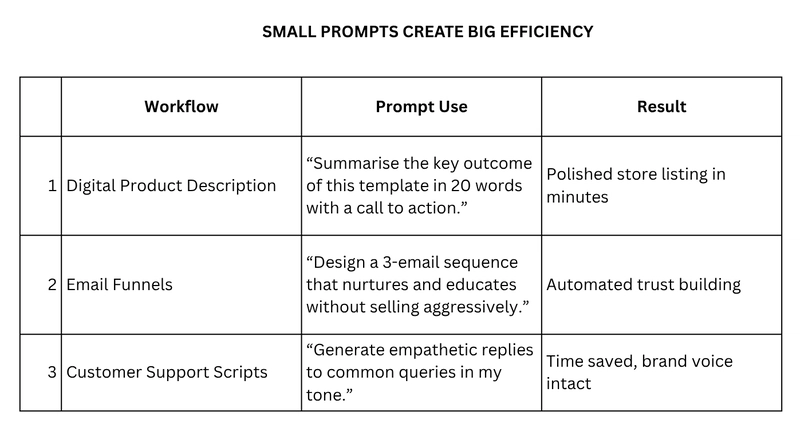
These aren’t cheat codes; they’re how you scale the stuff that matters. Set and forget, and let the system run.
5. Architecting Revenue With Prompts
My approach is: don’t just give AI to-dos—task it with building repeatable infrastructure.
- Every template, campaign, content calendar, and workflow is documented and systemized so anyone (human or future AI) can run them.
- The aim: turn creativity into frameworks that compound, not just single-use wins.
The key shift: use prompts for architectural thinking, not just faster work.
Core Mindset: Stop Chasing, Start Building
The old method: hustle for clients, gigs, and one-offs.
The new model: build pipelines powered by AI and prompts.
Don’t just “sell time for money”—package and scale your intelligence.
Those who master prompt engineering and system-building will future-proof their income beyond trading hours for pay.
Final Insight
Prompting isn’t just an operational tool—it’s a revenue model.
When you wield AI to build, publish, and scale automated systems, you aren’t just creating side income—you’re carving out real freedom.
Next Up:
Tomorrow I’ll share my favorite technique for prompt troubleshooting:
“From Boring to Brilliant: How I Transform Mediocre AI Outputs Into Gold.”
Original inspiration & credit—read more here.